Channel pinch-off is the condition where the MOSFET channel thins to zero at the drain end. It is the boundary between the MOSFET triode region (channel continuous end-to-end) and the MOSFET saturation region (channel pinched at the drain). It occurs exactly when
where is the drain-to-source voltage and the Overdrive voltage.
Why the drain end thins
What holds charge in the channel at any point is the gate-to-local-channel voltage. At the source end the channel is at (roughly) the source potential, so the gate sees the full and the channel is at its thickest. Moving toward the drain, the channel potential climbs (current flowing through the channel’s resistance produces an IR rise), so the gate-to-channel voltage shrinks along the length. The channel is therefore tapered: fat at the source, thin at the drain.
Raise and the drain end keeps thinning. When the drain-end channel voltage reaches , the gate-to-channel voltage there has dropped to exactly — the bare minimum to sustain inversion — so the channel charge at the drain end goes to zero. The channel has just pinched off. Equivalently, in terms of the gate-to-drain voltage, pinch-off is the point where , which rearranges to .
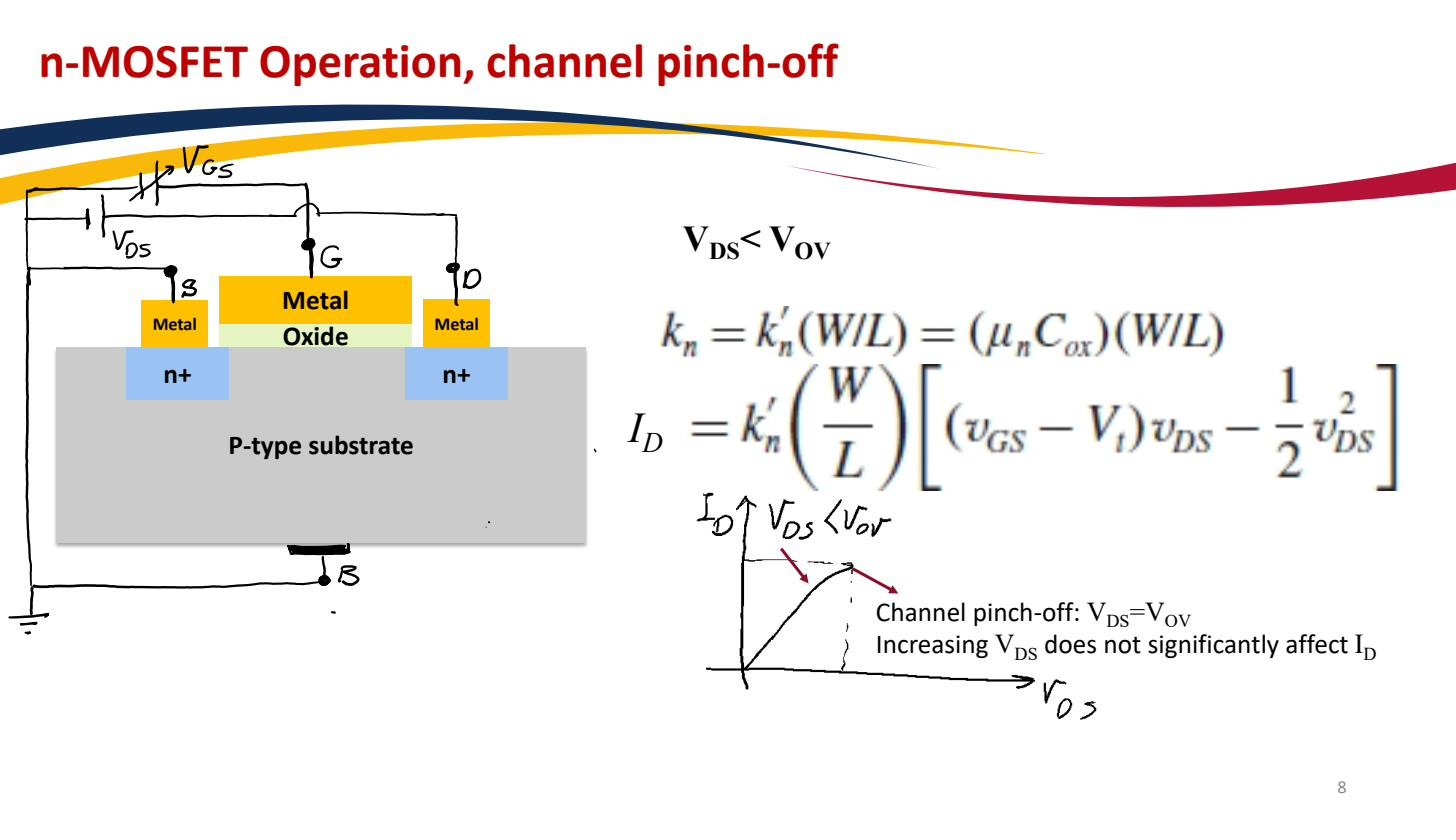 Pinch-off at : channel full at source, zero at drain.
What happens past pinch-off
Increasing beyond does not collapse the device. The channel is still fully formed near the source, where the current is set. The extra voltage drops across the narrow depletion region between the pinch-off point and the drain, and the strong field there sweeps electrons that reach the pinch-off point the rest of the way to the drain. Because the current is fixed by the still-intact source end, it becomes nearly independent of : this is the MOSFET saturation region and the MOSFET square-law.
A second-order effect: as rises further, the pinch-off point moves slightly back toward the source, shortening the effective channel and nudging the current up a little. That is Channel-length modulation, the reason a real MOSFET has a finite output resistance in saturation rather than a perfectly flat current.