An NMOS transistor (N-channel Metal-Oxide-Semiconductor field-effect transistor) is a switch controlled by a voltage on its gate. The actual turn-on condition is
where is the gate-to-source voltage and is the threshold voltage of the NMOS (typically – in modern processes, positive). When exceeds , an inversion layer of electrons forms under the gate and connects the drain to the source, so the channel conducts. Below the channel is off (sub-threshold leakage exists but is exponentially small).
In digital logic the gate is driven to either (off) or (on), with chosen well above . So as a switch model: gate high → conducting, gate low → open.
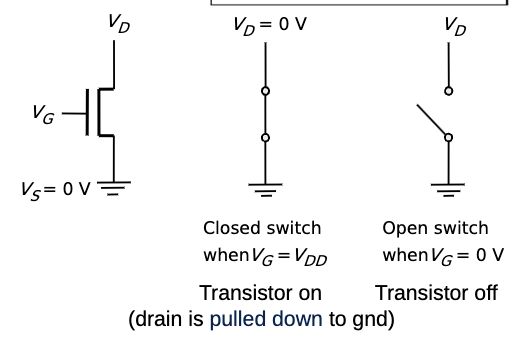
This is why NMOS sits in the pull-down network of a CMOS gate: it pulls the output low when its gate is driven high. It’s the natural switch for “this output should be when this input is .”
The three terminals are source, gate, and drain. Source is where charge carriers (electrons, in NMOS) enter the channel. Gate controls whether the channel conducts. Drain is where carriers leave. NMOS conventionally has tied to ground.
Threshold drop (“weak 1”)
Because the turn-on condition is , an NMOS used to pass a high signal degrades it: as the source voltage rises toward the gate, shrinks. Once reaches , has fallen to exactly and the channel cuts off. The output settles at rather than , a “weak 1.” This is why CMOS uses PMOS in the pull-up network and reserves NMOS for pulling low (where it produces a “strong 0”). It’s also why pass-transistor logic typically uses transmission gates (NMOS in parallel with PMOS) rather than bare NMOS pass transistors.
Pair an NMOS with a PMOS transistor of the opposite polarity and you get a CMOS gate that draws no static current.
Physical structure and analog operation (Electronics I)
Physically an n-MOSFET is built in a p-type substrate with two heavily-doped n+ regions forming the source and drain. Raising the gate above inverts the surface into an electron MOSFET channel connecting source to drain. The same device that acts as a digital pull-down switch is biased in the MOSFET saturation region for analog work, where its square-law current makes it the gain element of a Common-source amplifier. In saturation it’s also the standard analog transistor, not only a switch.