A diode-connected MOSFET has its gate shorted to its drain, turning the three-terminal transistor into a two-terminal nonlinear element that behaves much like a diode.
Why it is always saturated when conducting
Tie gate to drain and , so . The saturation condition is . Substituting :
which is always true (for a conducting n-MOSFET, ). So a diode-connected MOSFET sits in saturation automatically whenever it conducts. You never have to check the region or worry about it dropping into triode. That’s the appeal: it removes a case from the analysis.
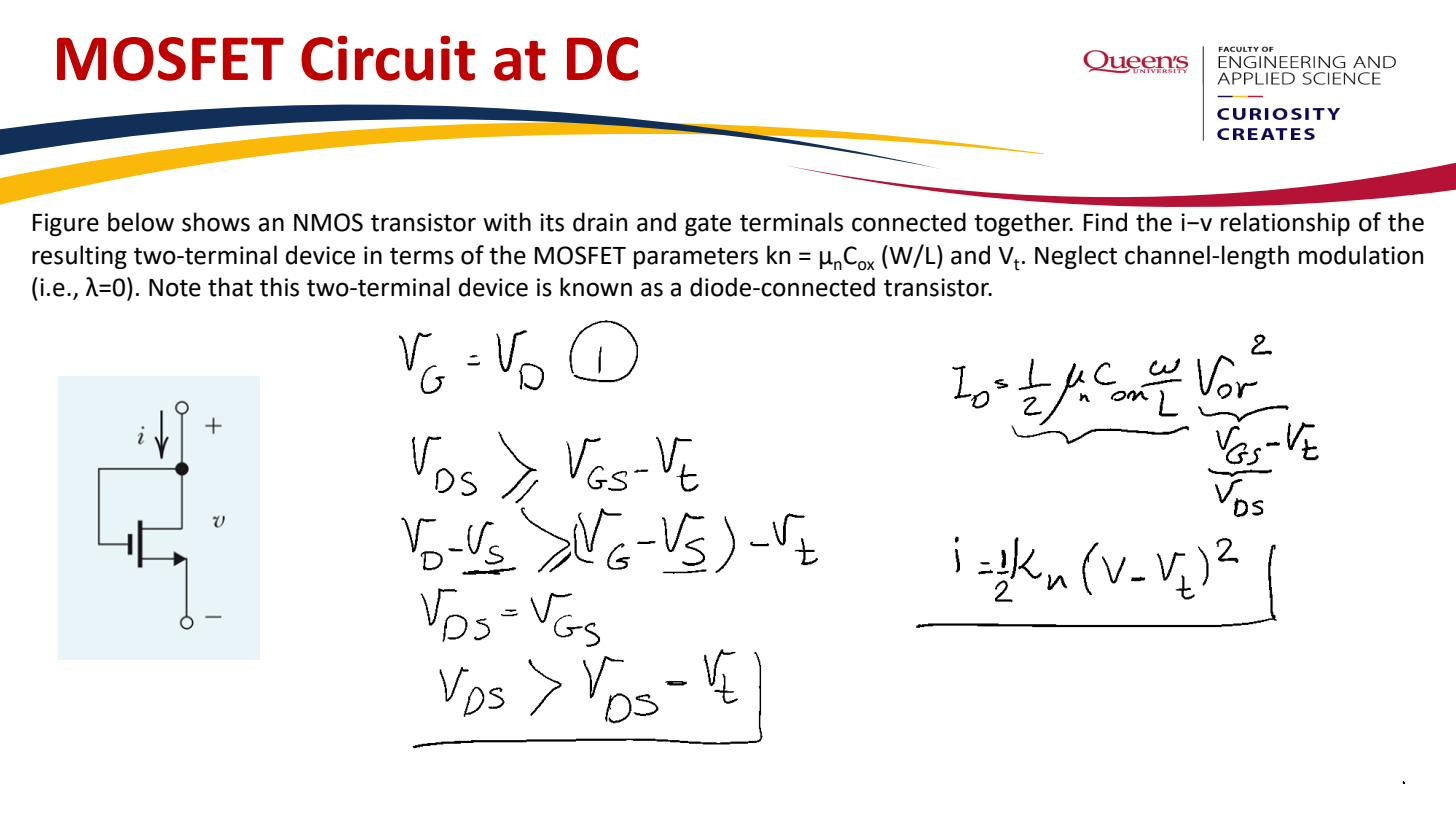 Gate shorted to drain. Always in saturation when it conducts; a two-terminal square-law element.
The two-terminal I–V
Because it is always saturated, its terminal current follows the MOSFET square-law with (the single terminal voltage across the device):
and for . Here is the device MOSFET transconductance parameter and the Threshold voltage. So the – curve is zero current until exceeds , then current rising quadratically. Qualitatively similar to a forward-biased Diode (turns on near , then conducts steeply), but square-law rather than exponential.
What it is used for
It’s the MOSFET counterpart of using a forward-biased diode as a Voltage reference: a soft, predictable voltage drop that depends on the current through it. Pass a known current and it develops a well-defined .