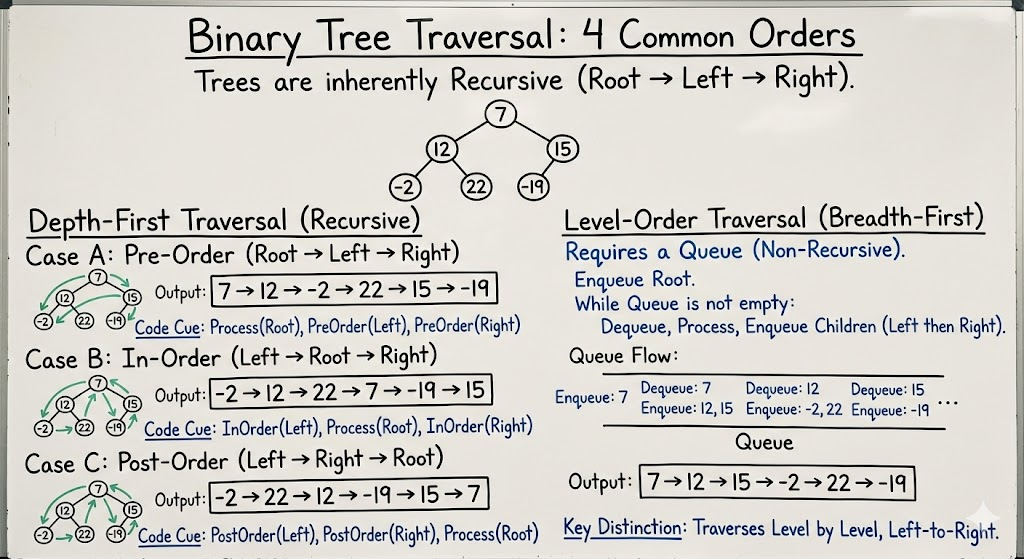
Binary tree traversal is visiting every node in a Binary tree exactly once. There are four standard orders, each with its own atomic note:
- Pre-order traversal — Root, Left, Right. Use for tree copying, prefix output.
- In-order traversal — Left, Root, Right. Use for BST sorted output.
- Post-order traversal — Left, Right, Root. Use for tree deletion, postfix output, recursive metrics.
- Level-order traversal — by depth, left to right. Use for shortest paths, layer-by-layer processing.
The first three (pre/in/post) are depth-first: they walk down one subtree to its leaves before backing up. They differ only in when the current node is processed relative to its left and right subtrees. All three use a stack — explicit or the call stack — and run in space where is tree height.
Level-order is breadth-first: it processes nodes by depth using a Queue. Structurally different; uses space where is the widest level.
Quick comparison
| Order | Sequence | Driver | Space | Sample use |
|---|---|---|---|---|
| Pre-order | Root, Left, Right | Stack | Tree copy, prefix expression | |
| In-order | Left, Root, Right | Stack | BST sorted output | |
| Post-order | Left, Right, Root | Stack | Tree deletion, postfix, recursive metrics | |
| Level-order | By depth, left-to-right | Queue | Shortest paths, layer processing |
All four are time — every node is visited exactly once.
Worked example tree
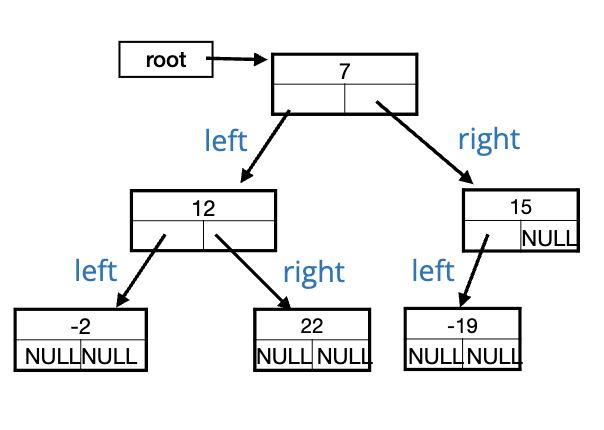
For consistency across the four child notes, the same tree is used in each:
            7
          /   \
        12     15
        / \    /
       -2 22  -19
| Order | Output |
|---|---|
| Pre-order | 7 12 -2 22 15 -19 |
| In-order | -2 12 22 7 -19 15 |
| Post-order | -2 22 12 -19 15 7 |
| Level-order | 7 12 15 -2 22 -19 |
(In-order’s output isn’t sorted because the tree isn’t a BST. On a BST, in-order does give sorted output — that’s its defining property.)
Picking an order
If you need…
- The parent before the children → pre-order.
- The values in sorted order from a BST → in-order.
- The children before the parent (deletion, computing parent value from child results) → post-order.
- Layer-by-layer / shortest-path-from-root semantics → level-order.
Generalisation to graphs
Tree traversals generalise directly to graph traversals — you just need a “visited” set to avoid revisiting nodes on cycles. The depth-first family becomes Depth-first search (DFS); level-order becomes Breadth-first search (BFS). Trees have no cycles, so the visited set is unnecessary for the tree cases above, but you need it the moment you traverse a general graph.