Pre-order traversal is a depth-first walk of a Binary tree that visits each node before its children: process the current node, then recursively traverse the left subtree, then the right. The acronym NLR (Node-Left-Right) captures the order.
preorder(root) → root, then preorder(left), then preorder(right)
Use it when you need the parent before its children: copying a tree, serialising it for transmission, prefix expression output.
Recursive implementation
void preorderPrint(BinaryTreeNode *cur) {
    if (cur == NULL) return;
    printf("%d ", cur->data);              // node first
    preorderPrint(cur->left);
    preorderPrint(cur->right);
}
The order of the three statements is the only difference between pre-, in-, and post-order. Move the print line to the middle for in-order, to the end for post-order.
Worked example
Take the standard sorted binary tree: root F; F’s children are B (left) and G (right); B’s children are A and D; D’s children are C and E; G has right child I, whose left child is H. Pre-order visits each node the moment it is first reached (shown by the arrows hitting the left of each node):
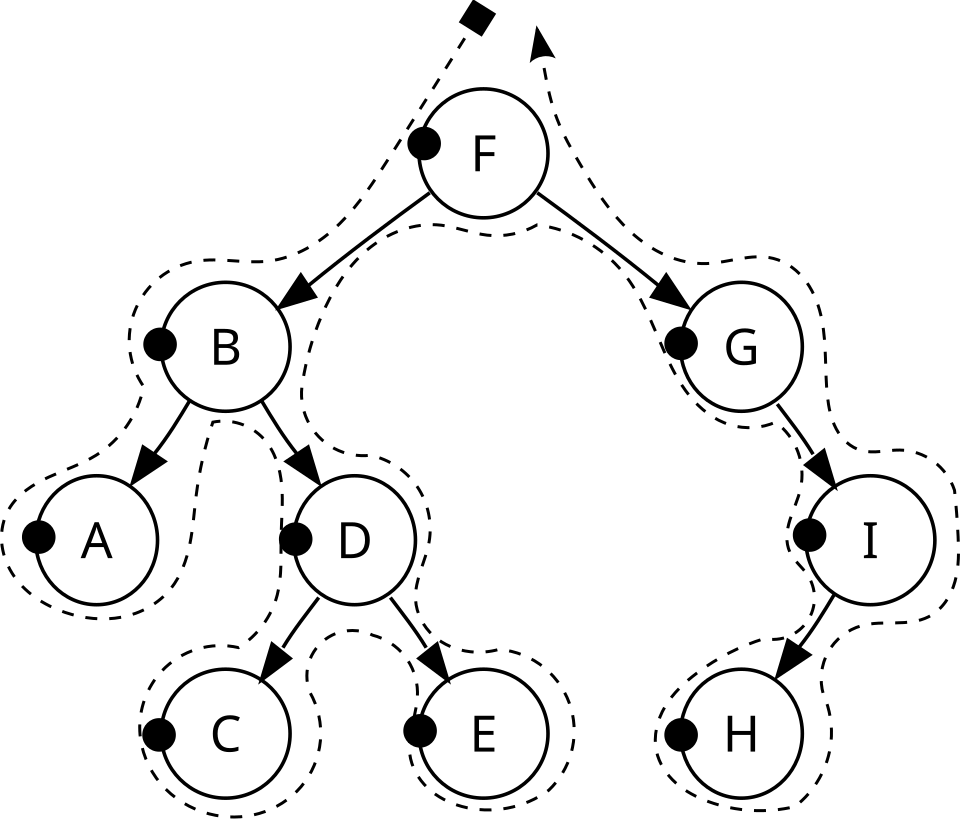 Image: Sorted binary tree showing pre-order traversal, public domain

Pre-order output: F B A D C E G I H
Trace:
- Visit F. Recurse left into B.
- Visit B. Recurse left into A.
- Visit A. Both children NULL — return.
- Back at B. Recurse right into D.
- Visit D. Recurse left into C (leaf) — return. Recurse right into E (leaf) — return.
- Back at F. Recurse right into G.
- Visit G. Left is NULL. Recurse right into I.
- Visit I. Recurse left into H (leaf) — return.
Final sequence: F B A D C E G I H.
Iterative implementation with an explicit stack
The recursion uses the call stack. To do it iteratively, simulate that stack:
void preorderIterative(BinaryTreeNode *root) {
    if (root == NULL) return;
    Stack s = stack_create();
    stack_push(&s, root);
    while (!stack_empty(&s)) {
        BinaryTreeNode *cur = stack_pop(&s);
        printf("%d ", cur->data);
        if (cur->right) stack_push(&s, cur->right);   // right first
        if (cur->left)  stack_push(&s, cur->left);    // so left pops first
    }
}
Push right before left so left is popped first — preserving root, left, right order. Same time complexity, but explicit memory rather than the call stack.
Use cases
- Tree copying. To copy a tree into a new structure, you need to create the parent node before its children — pre-order matches that.
- Serialisation / deserialisation. Writing a tree to disk in pre-order with NULL markers (
F B A # # D C # # E # # G # I H # # #) lets you reconstruct it by reading nodes in the same order. Used in interview questions and JSON tree formats. - Prefix (Polish) notation. Pre-order traversal of an expression tree produces prefix notation: becomes
* + a b c. - Directory listing. Print a folder before its contents — recursively descend and print each directory then its children.
- DFS variant. Pre-order is the binary-tree case of DFS’s “visit on first encounter” timing.
Complexity
Time: — each of nodes is processed once. Space: for the recursion stack, where is the tree height. For a balanced tree, ; for a degenerate (linked-list-like) tree, .
The iterative version uses the same stack space — just an explicit data structure instead of the call stack.
Comparison with the other orders
The four standard binary-tree traversals differ only in when the current node is visited and what data structure drives the walk:
| Order | Sequence | Driver | Use cases |
|---|---|---|---|
| Pre-order | Root, Left, Right | Stack / call stack | Copying, serialisation, prefix output |
| In-order | Left, Root, Right | Stack | BST sorted output |
| Post-order | Left, Right, Root | Stack | Deletion, postfix, recursive metrics |
| Level-order | By depth, left-to-right | Queue | Shortest paths, layer processing |
For the hub linking all four, see Binary tree traversal.