The common-gate amplifier drives the input at the source, takes the output at the drain, and holds the gate at AC ground. Non-inverting, low input resistance, and the natural current buffer of the MOSFET family.
Why the gain is positive
Hold the gate at AC ground and drive the source with . The gate-source voltage is gate minus source, and with the gate fixed at zero AC, . The drain current is then
That current flows in the drain branch. Taking the usual convention that drain current flows into the drain, the AC drain voltage is
so
Same gain magnitude as the Common-source amplifier, but a sign instead of . The double negative cancels out: the gate-source voltage inverts the input, and the drain inverts again.
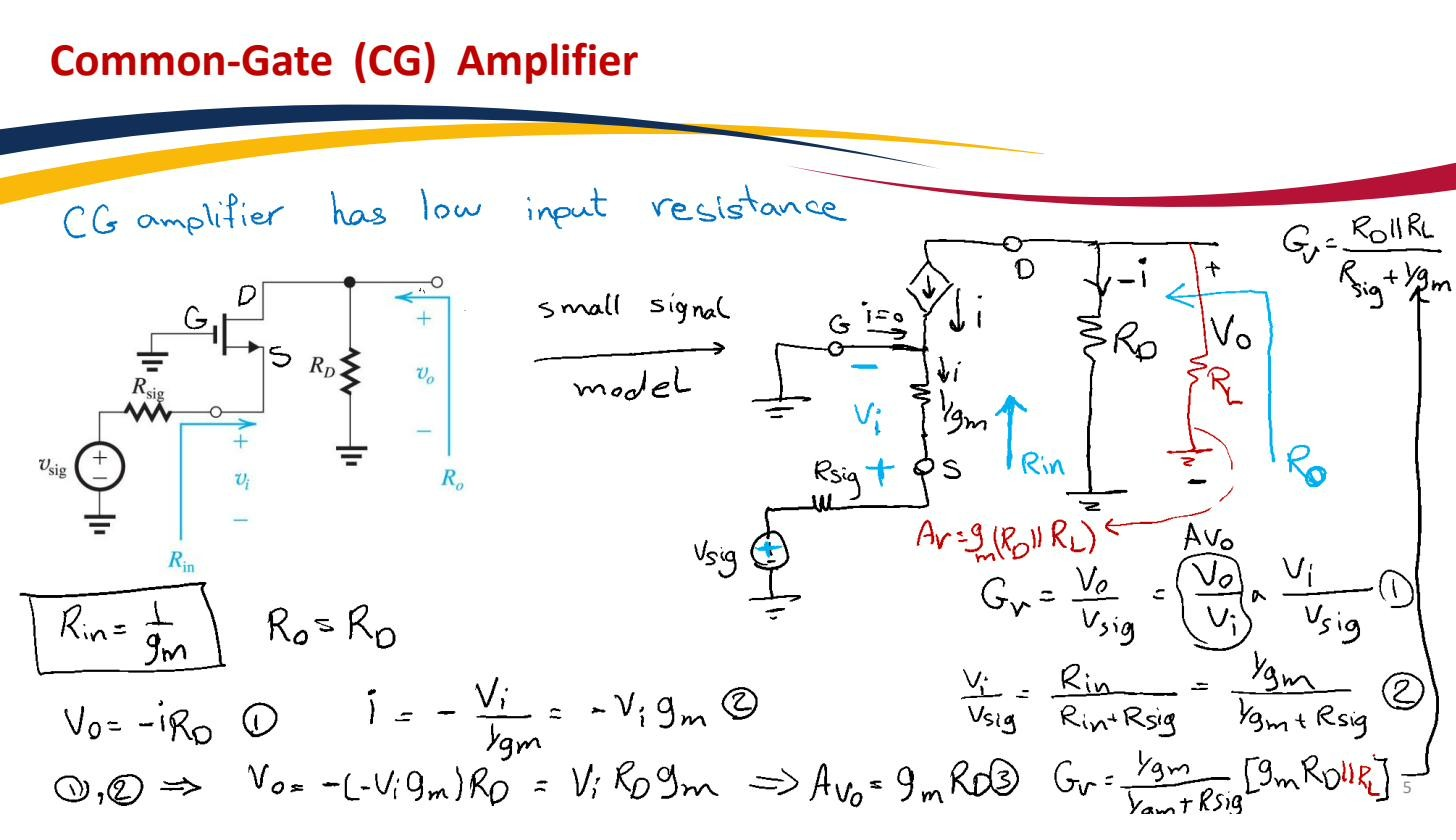 Input at source, output at drain, gate AC-grounded; non-inverting, low .
Low input resistance, high output resistance
Looking into the source you see the transistor’s source terminal, which presents
typically only a few hundred ohms. That low value is the defining trait of the common gate. The MOSFET T-model makes it fall straight out: the element sits exactly between gate and source, so it is what you look into from the source. This result neglects the transistor’s output resistance . Including it, the exact input resistance is , which actually depends on the drain load . For the usual case with a modest it collapses back to , which is why the simple form is used at this level. The output resistance at the drain is high by contrast, much higher than the common-source case.
What it is good for
A low input resistance is bad for voltage amplification from a high-impedance source, since you lose most of the signal in input loading. But it makes the common gate a good current buffer: it takes a current at its low-impedance input and delivers it to a high-impedance output essentially unchanged. Its real use is as the top half of the cascode (a Common-source amplifier feeding a common gate), where the CS stage’s transconductance and the CG stage’s high output resistance combine to build the very high-gain stages inside op-amps.