The Exponential diode model gives a transcendental equation with no closed-form solution: together with . Iterate to the answer numerically by alternating between the KVL equation and the inverted Diode equation.
The recipe
- Guess a value for . Start with 0.7 V; the Constant-voltage-drop model answer is a good first guess.
- Compute from KVL using the current guess: .
- Refine from the diode equation, inverse form: .
- Repeat steps 2–3 with the refined until the value stops changing to the precision you need. Two or three passes are normally enough.
It converges fast because the logarithm in step 3 is extremely insensitive: even a large error in produces only a small correction to (a factor-of-10 error in moves by only mV). The same steepness that makes the equation annoying to solve directly is what makes the iteration converge in a few steps.
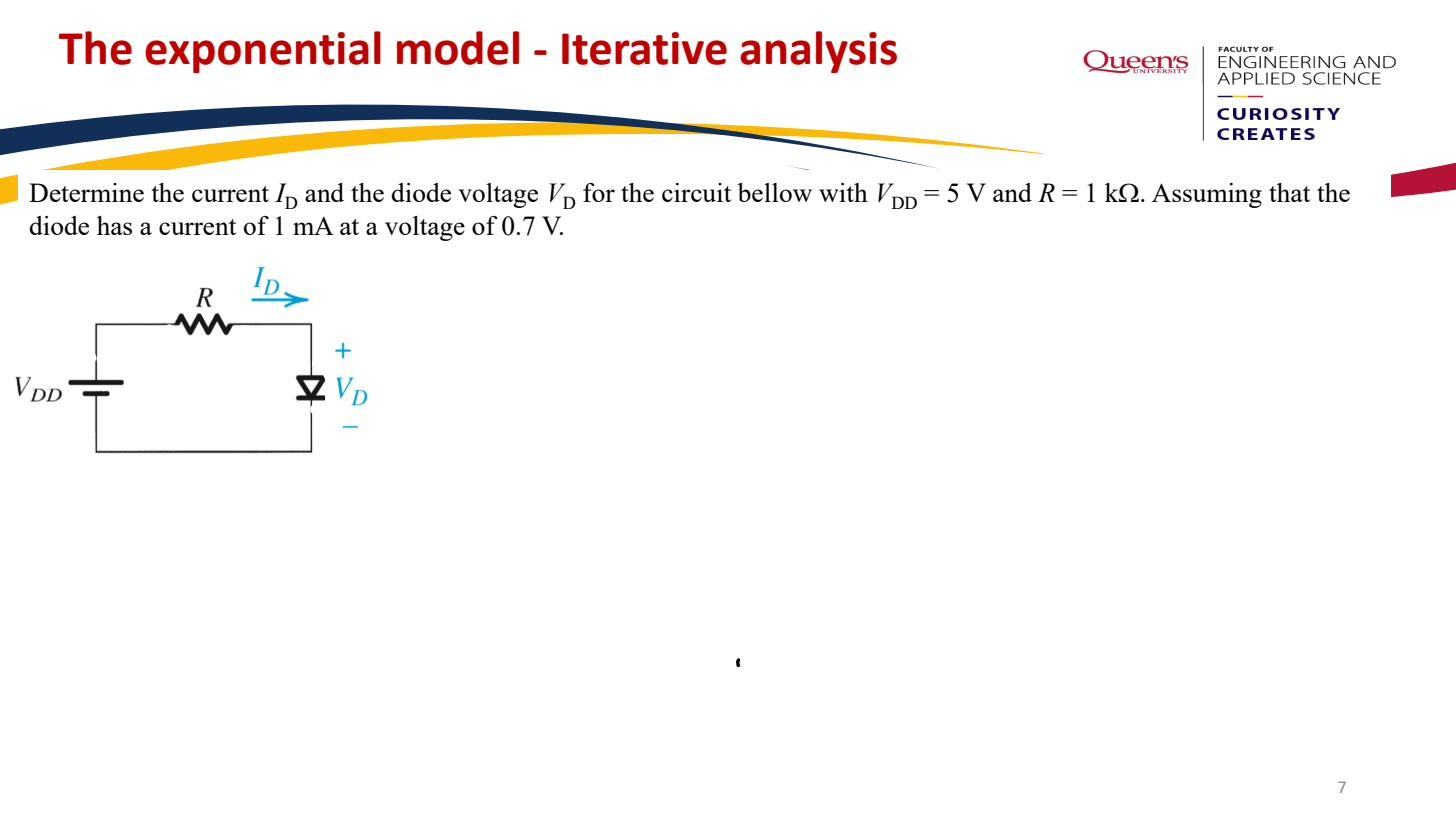 Guess , get from KVL, refine from the diode equation, iterate to convergence.
Worked numeric pass
Take V, k, and a diode with A, mV.
Iteration 1. Guess V. Step 2: mA. Step 3: V.
Iteration 2. Use V. Step 2: mA. Step 3: V.
The voltage has already stabilised at V with mA. This is close to the Constant-voltage-drop model answer (0.7 V, 4.3 mA): the iteration mostly confirms the CVD model was already good. That’s why CVD is the default and the exponential model gets saved for cases that need the extra accuracy.