The constant-voltage-drop (CVD) model approximates the Diode by saying: when on, the voltage across it is a fixed V; when off, no current flows (open circuit). It’s the diode model you reach for first in hand analysis because it captures the one fact that matters (a conducting silicon diode drops about 0.7 V) without the transcendental algebra.
Why 0.7 V is a good constant
The Diode equation is exponential, so every decade of current costs only about 60 mV of extra . Across the whole practical current range a small-signal silicon diode sits between roughly 0.6 V and 0.8 V. The CVD model pins that to a single number, 0.7 V, and treats it as a fixed source. A conducting diode becomes a 0.7 V battery (+ terminal at the anode), a non-conducting diode an open circuit. The exact value is convention: 0.7 V is standard, some texts use 0.6 V or 0.65 V.
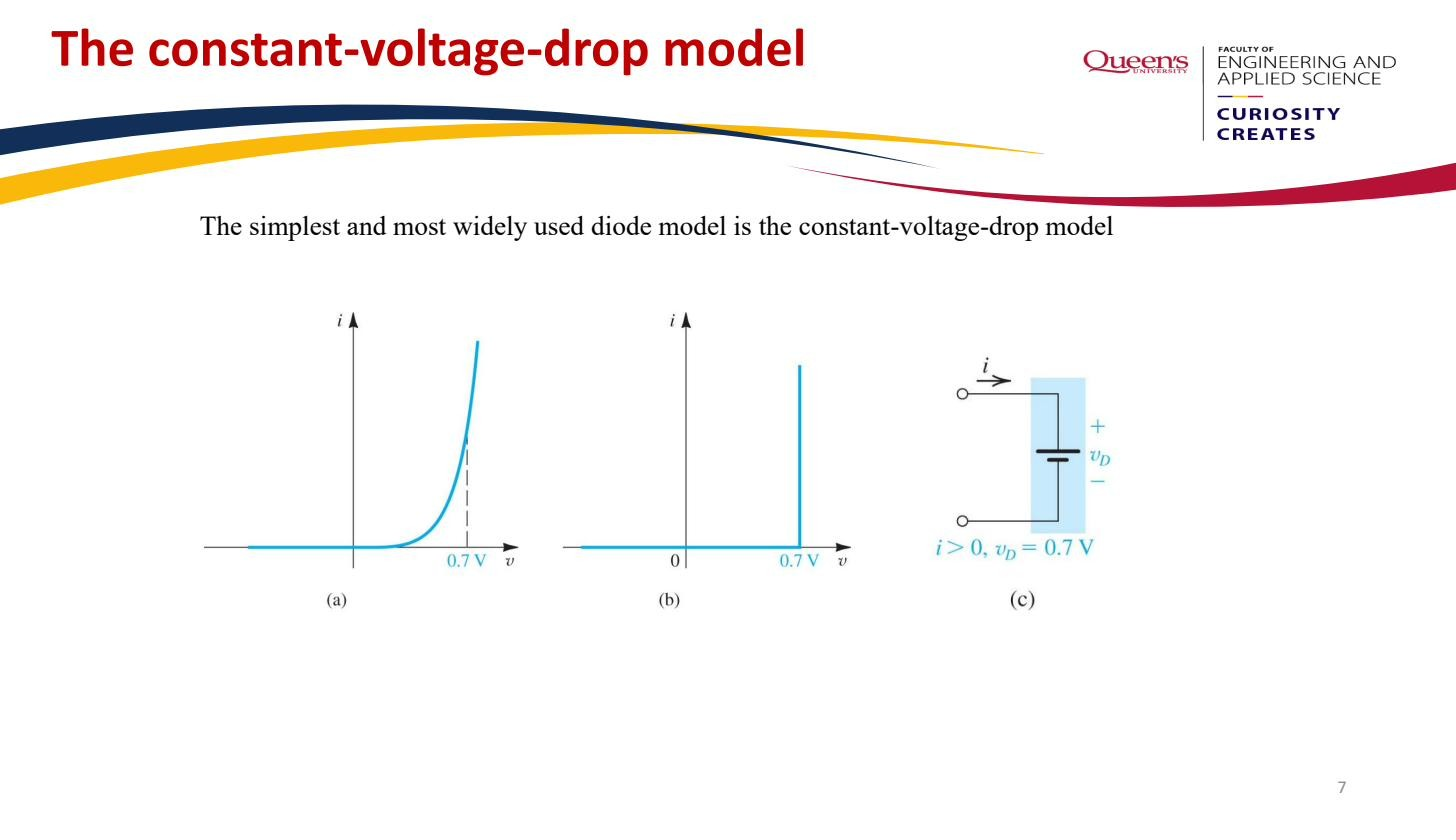 The diode becomes a 0.7 V battery when on, an open circuit when off.
As with the Ideal diode model, you must assume a state, solve, and check it. Assuming “on”, a valid result has (current really flowing anode→cathode). Assuming “off”, a valid result has the diode reverse biased ().
Worked example
A 5 V supply, a 1 kΩ resistor, and a diode in series. Assume the diode is forward biased, so the CVD model replaces it with a 0.7 V drop. Apply Kirchhoff’s voltage law around the loop:
Solve for the diode current:
That’s the whole analysis. Two relations, the KVL equation and the model’s V, give the Operating point directly, no iteration. Check the assumption: mA is positive, so the diode really is forward biased and the assumption holds.
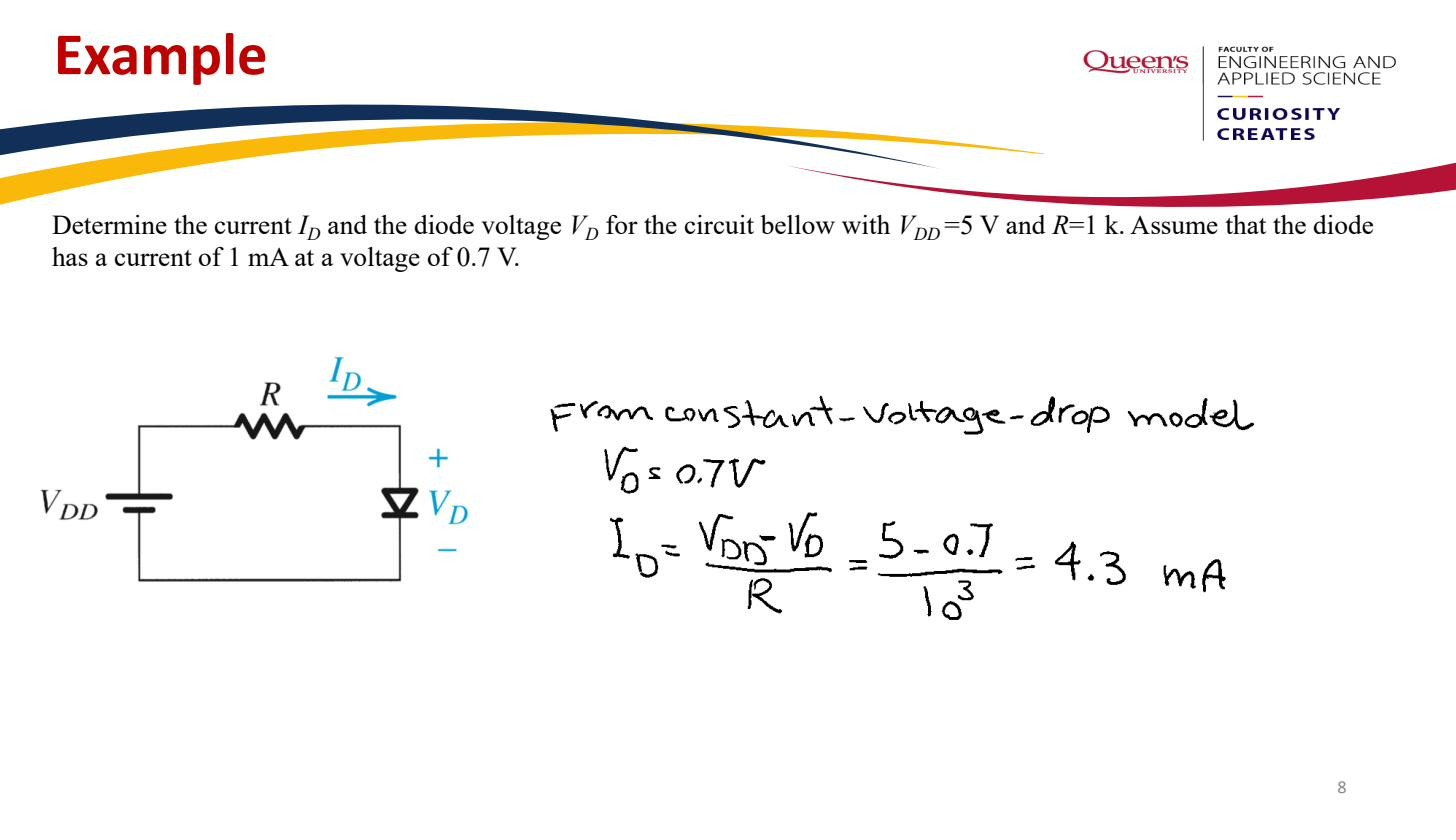 Worked example: V, kΩ, V ⇒ mA via KVL.
The Exponential diode model would give a slightly different (the true at 4.3 mA isn’t exactly 0.7 V) at the cost of Iterative diode analysis. For most circuits the CVD answer is close enough that the extra work isn’t worth it.