The exponential diode model uses the full Diode equation as the diode’s – relation, with no linearising approximation. Most accurate large-signal model, least convenient to use: combining the exponential with the rest of the circuit produces a transcendental equation with no closed-form solution.
Where the transcendental equation comes from
Take the worked circuit from the Constant-voltage-drop model: a supply , a series resistor , and a diode. Kirchhoff’s voltage law gives
That is one equation in two unknowns (, ). The second equation is the diode’s own characteristic:
Substitute the diode equation into the KVL equation:
Now appears both inside an exponential and outside it as a linear term. No algebraic rearrangement isolates ; this is a transcendental equation. You can’t write . The way out is Iterative diode analysis: guess, compute, refine, repeat until the value stops changing. A graphical load-line intersection (the diode curve crossed with the resistor’s straight line) is the same solution viewed geometrically.
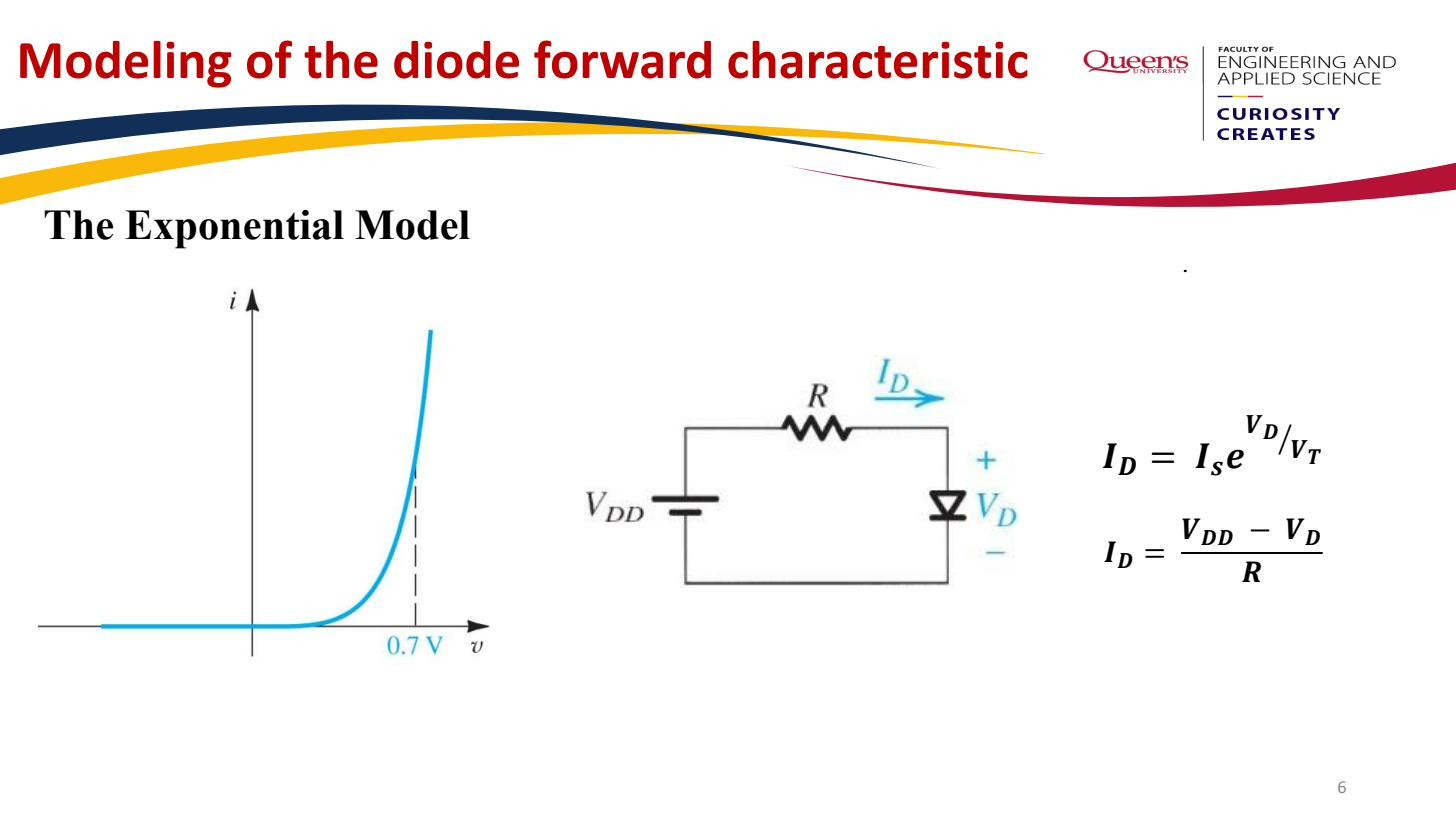 Diode equation + KVL gives a transcendental equation, solved iteratively.
When it is worth it
Use the exponential model only when you need accuracy the Constant-voltage-drop model can’t give: when the answer depends sensitively on the exact diode voltage (precision references, log amplifiers, exponential temperature compensation), or when the diode current is far from the value at which “0.7 V” was calibrated. For ordinary rectifier and switching analysis the CVD model is close enough and the iteration isn’t worth the effort. This model is also the starting point for the Diode small-signal resistance: differentiate the exponential at the operating point to get .