Reverse bias switches a PN junction off: p-side to the negative terminal of the supply, n-side to the positive terminal. The applied voltage adds to the built-in barrier, almost no current flows, and the junction acts like an open switch.
What the applied voltage does
Connect p to and n to . The external field pulls holes in the p-side away from the junction and electrons in the n-side away too, reinforcing rather than opposing the built-in field. The barrier a carrier must climb to cross is raised:
where is the Built-in voltage and the applied reverse voltage. A taller barrier means an exponentially smaller fraction of majority carriers can surmount it, so the large forward diffusion current is choked off almost completely. The majority carriers retreat from the junction rather than crossing it.
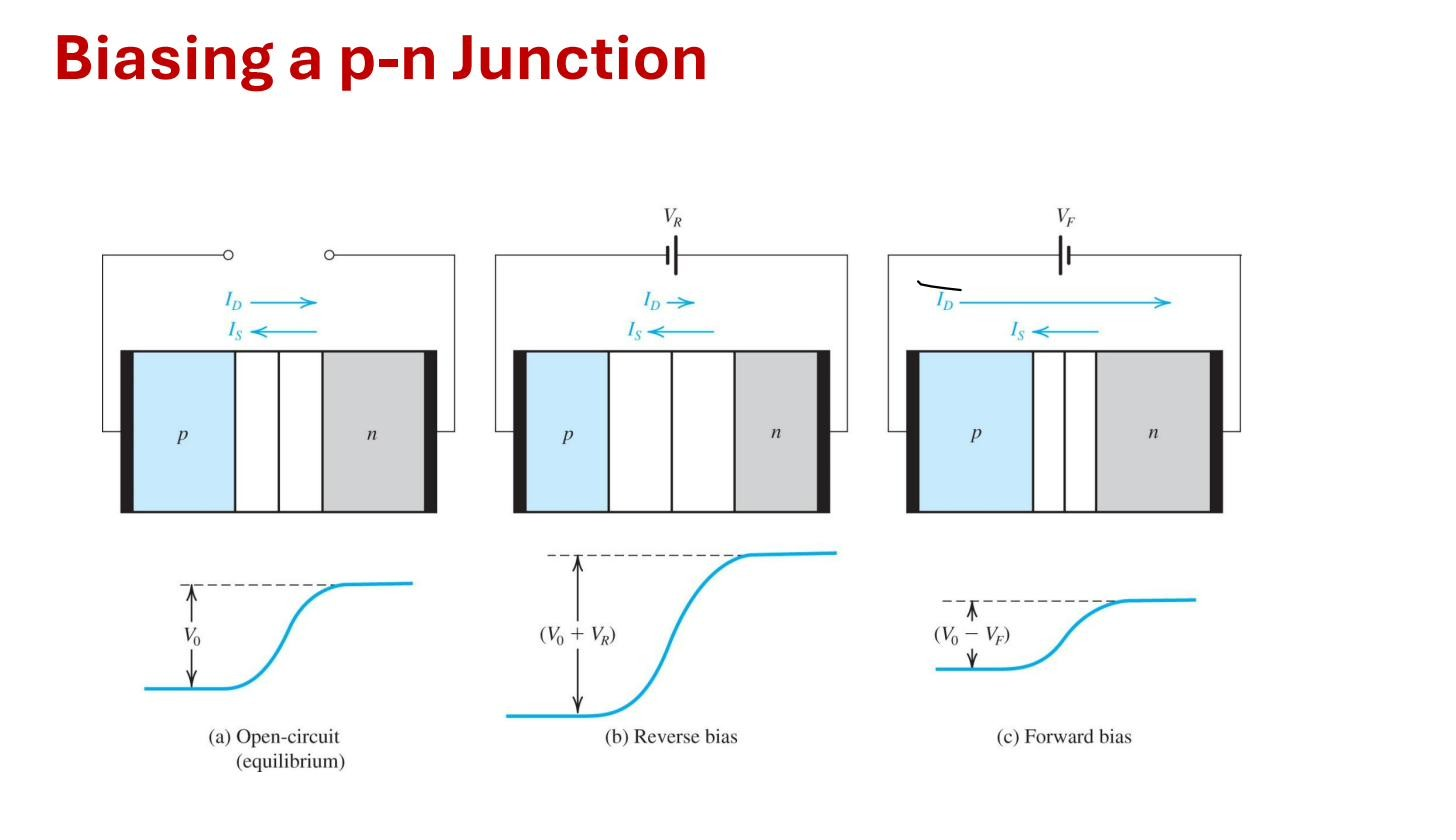 Forward bias lowers the barrier (large diffusion current); reverse bias raises it (blocked).
The only current: reverse saturation current
The junction is not perfectly off. A tiny current still flows, the Reverse saturation current . It is carried not by the abundant majority carriers (which are blocked) but by the scarce minority carriers: the few stray electrons in the p-region and the few stray holes in the n-region. Any minority carrier that wanders into the junction’s field is swept across by it; the raised barrier does not impede them because they are going downhill. Their supply is limited by thermal generation, so is very small (typically to ) and roughly independent of the reverse voltage. For practical purposes the diode is off.
The depletion region widens
Because the net junction potential rises to , the Depletion region width (which scales with the square root of that potential) grows. More dopant ions are uncovered, the field-bearing region gets thicker, and the stored junction charge changes with voltage. That’s the basis of the voltage-variable junction capacitance used in varactor diodes.
The limit: breakdown
Reverse bias only holds off current up to a point. Push the reverse voltage high enough and the junction abruptly conducts hard via avalanche or Zener mechanisms (see Reverse breakdown). Below that breakdown voltage, reverse bias is the “off” half of the diode’s one-way-valve behaviour, and together with Forward bias it makes the PN junction useful as a switch and rectifier.