Push a reverse-biased Diode past a critical reverse voltage and instead of blocking it suddenly conducts heavily in the reverse direction. The voltage at which this onset happens is the breakdown voltage .
What actually happens
In Reverse bias the standard story is “no current flows”, just the tiny Reverse saturation current . That only holds up to a point. As the reverse voltage climbs, the electric field across the depletion region of the PN junction grows. Past a critical field the junction breaks down by one of two mechanisms. In the avalanche mechanism, carriers accelerated by the field gain enough energy to knock other electrons free on impact, which knock more free, in a multiplying chain. In the Zener (tunnelling) mechanism, which dominates at low breakdown voltages, the field is strong enough that electrons tunnel directly across the junction. Either way the current rises almost vertically with no further increase in voltage.
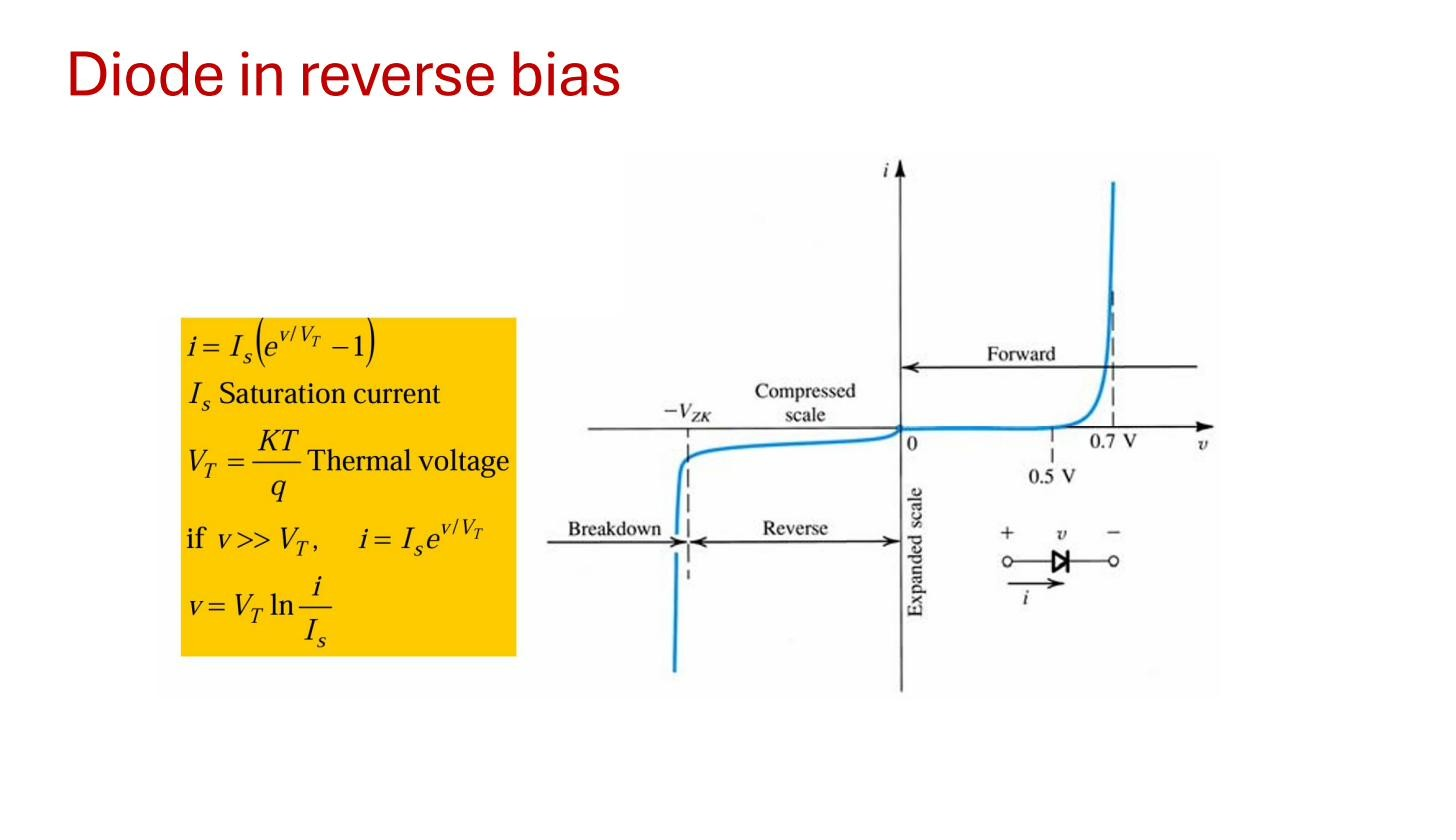 Reverse current stays at the small saturation value until breakdown , then rises sharply.
Destructive vs. engineered
Breakdown itself does not destroy a junction, heat does. The power dissipated in breakdown is , and with the steep curve a small voltage overshoot causes a huge current. For an ordinary signal or rectifier diode, with no external resistor to limit the current, exceeding runs the power dissipation away and cooks the device. That is why a diode’s reverse voltage rating (Peak inverse voltage) must never be exceeded in a rectifier.
But the breakdown region is flat in voltage: a large change in current barely moves the voltage. That is exactly the behaviour you want from a voltage reference. The Zener diode is engineered to break down at a precisely controlled and, with a series current-limiting resistor keeping the dissipation safe, to operate reliably in this region. That is the basis of the Zener voltage regulator.