The common-emitter current gain, written (and called on datasheets), is the ratio of collector current to base current in a BJT operating in active mode:
The headline parameter of a BJT. It says how much collector current you get for a given base current, the device’s current amplification. Typical values are 50 to 100, with some processes reaching the high hundreds or even ~1000.
Where it comes from
In active mode the emitter injects a large carrier current into the thin base (Minority-carrier injection). Almost all of those carriers diffuse across and become collector current; a small fraction recombine in the base on the way, and that lost fraction is the base current. So is small, is large, and their ratio is large. A bigger means a thinner, more lightly-doped base, fewer carriers lost to recombination.
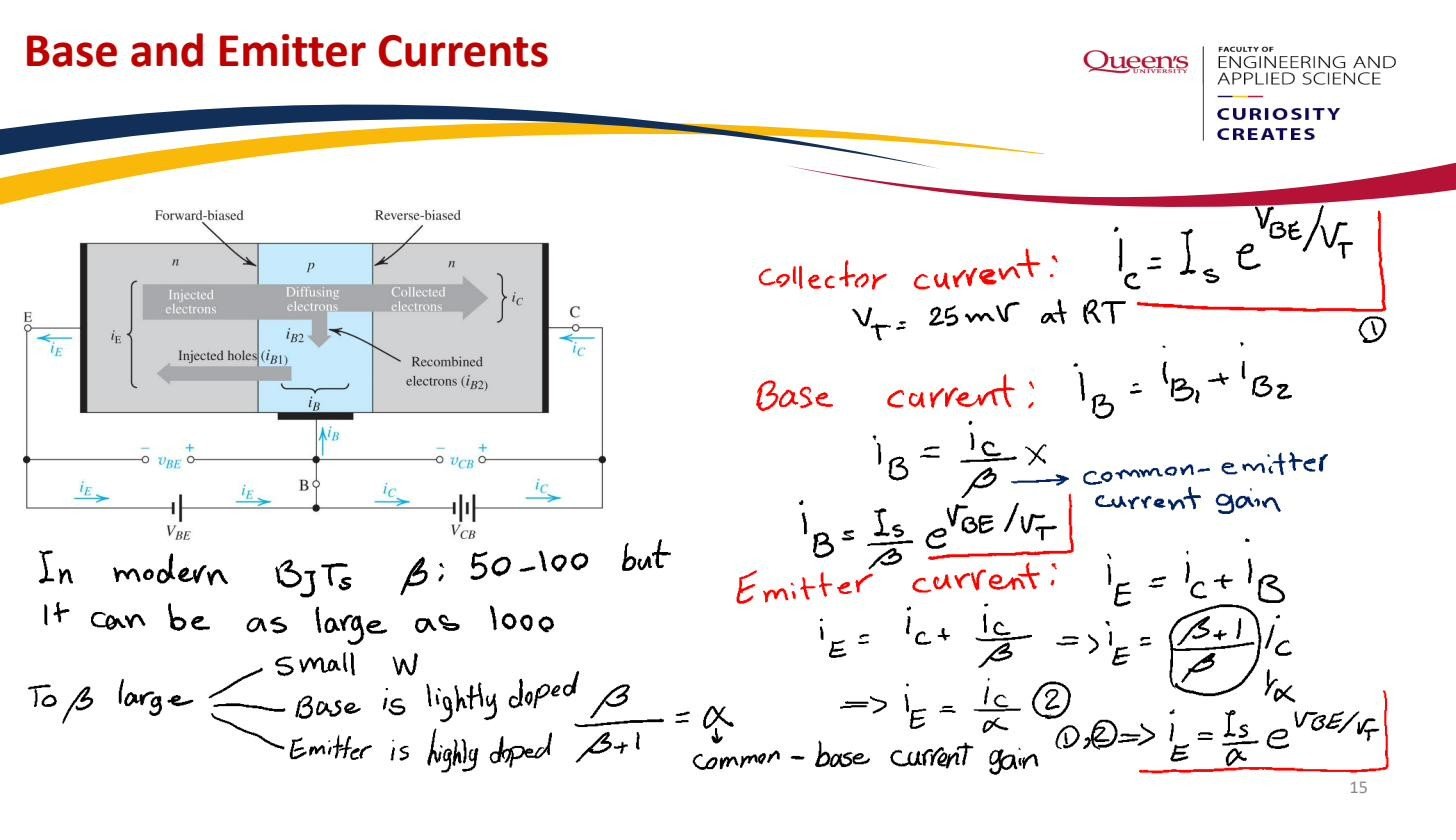 A small fraction of the emitter current is lost to recombination in the base, becoming the base current; the rest reaches the collector.
Relation to α and KCL
A BJT has only three terminals, so by KCL the emitter current is the sum of the other two:
The Common-base current gain is the other ratio. The two are not independent — knowing one (plus the KCL constraint) gives the other. Starting from and dividing through by :
so , and inverting that,
A worked check: . Conversely . Because is so close to 1, a tiny change in swings enormously, which is also why varies widely between devices and with temperature, and why good bias circuits (Voltage-divider bias, Emitter degeneration) are designed to be insensitive to .
From you also get , the form used throughout BJT DC analysis. The factor between base and emitter currents is exactly what powers the Resistance reflection rule.