The BJT input resistance is the small-signal resistance seen looking into the base of a BJT in active mode:
Unlike the MOSFET, whose gate is insulated by oxide and draws no DC current (infinite input resistance), the BJT base passes a real base current. Apply a small AC voltage across base-emitter and an AC base current flows; their ratio is a finite resistance.
Derivation
The collector responds to through the transconductance: . The base only ever carries of the collector current (that is the definition of the Common-emitter current gain ), so
Therefore the resistance looking into the base is
Substituting gives the equivalent form .
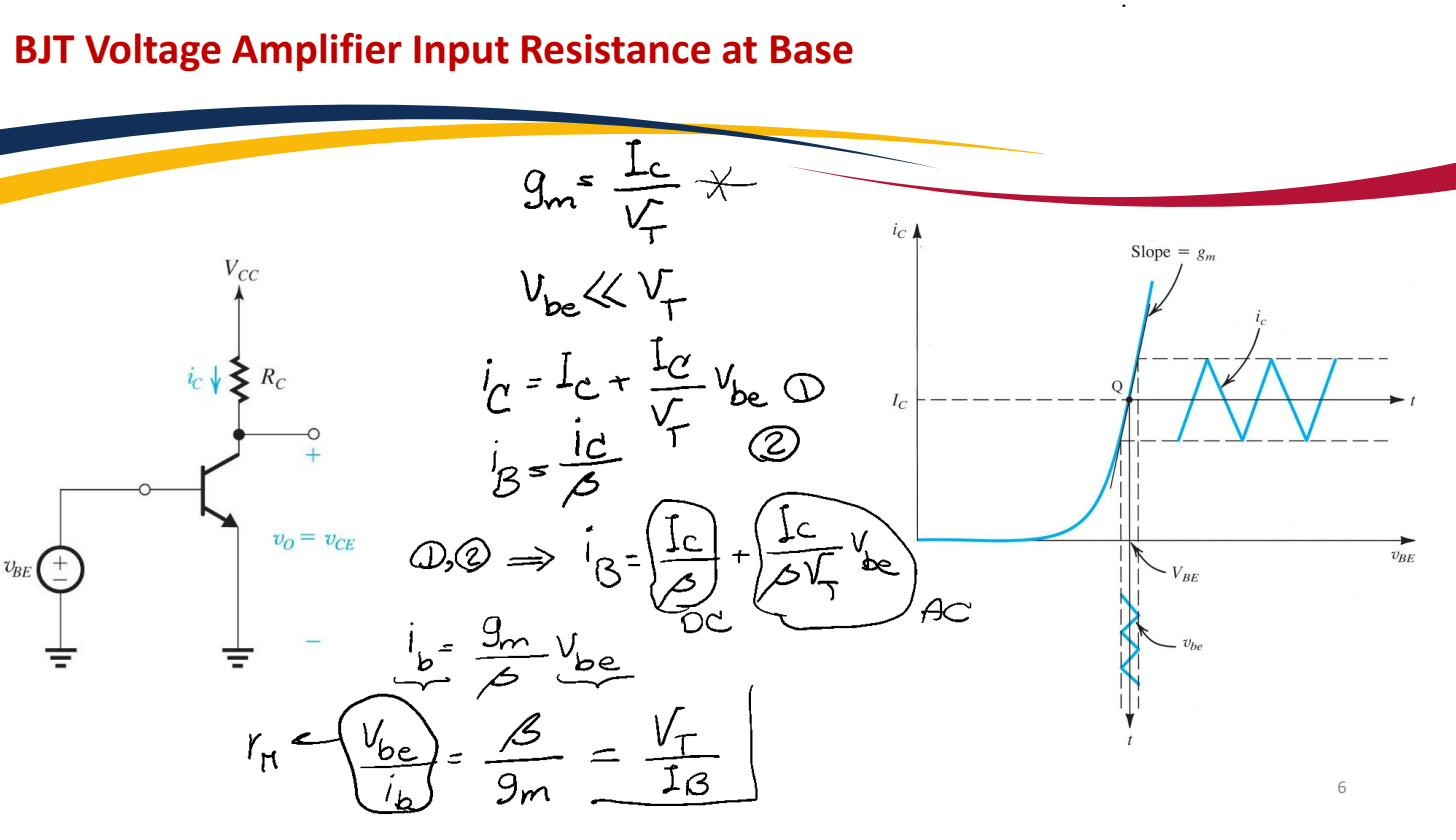 BJT input resistance at the base: . Finite (unlike the MOSFET), a few kΩ at standard bias currents.
Numbers
At with and :
A few kilo-ohms matters: many real signal sources have output impedances comparable to or larger than this, so a Common-emitter amplifier loads its source noticeably. This is one of the few genuine disadvantages of the BJT versus the MOSFET in amplifier design. A common-source MOSFET stage presents an essentially infinite input resistance, a common-emitter BJT stage only .
scales with and inversely with , so bias the device at a lower current to raise its input resistance (at the cost of lower ). It’s the base-emitter element of the hybrid-π form of the BJT small-signal model. The much smaller resistance looking into the emitter instead is , the Emitter resistance; the difference is which terminal carries the full current.